All What An Assistive Dogs Can Bring To The Family

The proverb says: The dog is man’s best friend. Dogs are loyal and they love their masters unconditionally (I prefer to use the word masters over owners). They communicate without language, and understand the body language. If your child doesn’t talk or has poor verbal skills she/he can still have a social life. A dog would be a close friend, … Read more

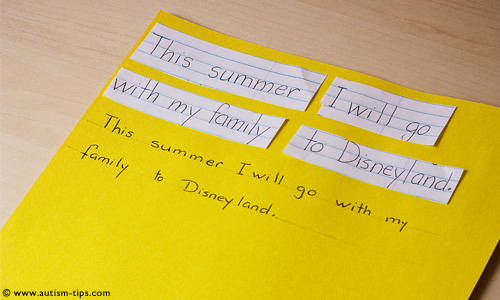
A Simple Tip to Improve Speech

I learned this technique from a great speech pathologist. She recommended it to be used for an autistic boy with very poor speech and verbal skills. She gave me a binder full of pictures (around thirty pictures). The pictures were simple, colorful with large details. The pictures should also appeal to the children. The technique worked … Read more

Eye Contact

The human development has three components: Physical (body), cognitive (learning), and socio-emotional development. The three components are tightly related and should develop harmoniously and simultaneously from the first day of birth. (1) For a typically developed child the vision skills must develop automatically along with the motor and cognitive (learning) skills. Many children with autism … Read more

Mainstreaming

The ultimate goal in special education is to help as many children as possible to get to the appropriate level of mainstream education. By mainstream, we mean a regular education class for typically developed children. The average number of kids in lower grade (kindergarten, first, second and third grade) is about twenty kids, and some thirty … Read more

Teach Flexibility

One of the most characteristic traits of autism is rigidity, inflexibility, love for sameness and repetitive behavior. Why? Because it is easier to redo something than do something new. Even neurotypical people have a hard time making changes in their lives. It is easier to keep a routine. Change always comes with some effort. Tips … Read more

Sensory Problems

What appears to us as a misbehavior, is in fact a reaction of autistic children to their overwhelming environment. Often times they are oversensitive (hypersensitive). On the other hand, they can be indifferent to the input to their senses or under sensitive (hypo sensitive). If they get overstimulated they try to do anything to self-regulate … Read more

Be Positive

When you tell a child — especially with special needs — “don’t“, you leave her/him with no options. When you give an alternative or a substitute, you are giving her/him an opportunity to correct or modify the inappropriate behavior or action. What should you do? Use the affirmative form instead of the negative form when you … Read more

Visual Timer

Autistic children rely intensively on their visual skills. I always make sure to use a visual timer along with the daily schedule. The visual timer has the advantage of giving a real feeling of time. It helps estimate the elapsed time and anticipate the remaining time. It compares to the difference between a digital watch … Read more

Comprehension Check

There is a way to go into the mind of kids with poor verbal skills and check their understanding of  language. This activity engages several senses along with the thinking process. The kids usually like it because it appears to them as a game. I like doing this activity especially in the afternoon when the … Read more